Point-to-Point Hiking in Italy: A Sustainable Journey Through Umbria and Lazio
Between Florence and Rome lies a quieter side of Italy - one of volcanic lakes, empty walking trails, Renaissance hill towns and long lunches in the countryside. Over five days, we hiked point-to-point through Umbria and Lazio carrying everything on our backs, following sections of the Via Francigena through landscapes that felt untouched by mass tourism. Travelling slowly on foot turned this stretch of central Italy into something far richer than a typical itinerary: not just a route between places, but a way of fully inhabiting them.
What’s the story, where is Umbria and Lazio?
Nestled in the very centre of Italy, Umbria and Lazio sit quietly in the space between better-known neighbours, Tuscany to the north and Rome to the south, but they feel like a world apart once you step onto their trails. This is a landscape of soft, rolling hills, volcanic lakes, medieval hill towns perched on ridgelines, and long, empty paths where the rhythm of walking quickly replaces the noise of modern travel. It is Italy at a slower cadence: less curated, more lived-in, and deeply shaped by centuries of movement on foot.
Two ancient routes help explain this landscape. In Umbria, the Larth Way traces a quieter path through Etruscan territory, threading together rural tracks, historic settlements and archaeological echoes of one of Italy’s earliest civilisations - a reminder that this land has always been crossed, settled, and re-crossed by travellers long before modern tourism. Running more prominently through both regions is the Via Francigena, the medieval pilgrimage route that once carried travellers from Canterbury to Rome. In Umbria, sections of this route still wind through hill towns, farmland and forest, offering today’s walkers a rare continuity with centuries of pilgrimage, trade and slow, purposeful movement through the heart of Italy.
Getting there
Umbria and Lazio are best accessed via Rome, which acts as the main international gateway to central Italy. All major airlines fly into Rome Fiumicino Airport (FCO), and the city is also well connected by high-speed rail from across Europe, making it an easy starting point for a walking trip in the region.
From Rome, take the regional train to Orvieto - services run regularly throughout the day on the Trenitalia regional line (Regionale Veloce). Depending on the time of departure, you may need to change at Orte, but connections are straightforward and well signposted. The journey is inexpensive, typically around €10 return per person, making it one of the easiest and most affordable rail links into the Umbrian countryside.
Orvieto is both the start and finish point of this hike - a dramatic hill town rising above volcanic cliffs, and the perfect place to begin and end a slow journey on foot into Umbria and Lazio.
We spent our first night in the ancient walled old town of Orvieto itself, arriving by train before taking the funicular straight up the steep hillside from the station into the historic centre. It is an effortless ascent that feels like a threshold between two worlds: the modern rail line below and the medieval city above. Once inside the old town, there is a wide range of accommodation, from cosy B&Bs to elegant five-star hotels, all tucked within a compact network of stone streets.
We stayed in a simple, comfortable boutique hotel right beside the Duomo, which made for an especially atmospheric base. That first evening was spent wandering the maze of cobbled streets, stepping into a small microbrewery for a drink, enjoying dinner al fresco in the warm evening air, and finishing the night with a final nightcap at an enoteca.
Orvieto Cathedral makes a good starting point
Orvieto to Bolsena (21 km)
Cobbled streets of Bolsena
Leaving the dramatic cliff-top city of Orvieto behind, the trail begins gently, winding through the rolling Umbrian countryside before crossing into northern Lazio. Unlike the steeper mountain hikes I often gravitate towards, this stage is wonderfully forgiving, with long, gradual inclines that allow you to settle into an easy rhythm and simply enjoy the landscape.
Much of the route passes through peaceful native woodland, where ancient oak groves provide welcome shade from the Italian sun. Dry-stone walls border quiet country lanes, while open fields burst with seasonal wildflowers, creating a patchwork of colour that changes with every bend in the path. It is the kind of walking that encourages you to slow down, notice the birdsong, breathe in the scent of warm woodland, and appreciate the simple pleasure of putting one foot in front of the other.
One of the unexpected highlights of the day was stumbling across a tiny microbrewery in what felt like the middle of nowhere. After hours on the trail, sitting in the shade with a couple of locally brewed beers was the perfect excuse to pause before tackling the final kilometres into Bolsena.
As the afternoon wore on, the shimmering waters of Lake Bolsena gradually came into view. Formed within the crater of an ancient volcano, it is Europe's largest volcanic lake, and the medieval town of Bolsena occupies one of its most picturesque shores. Its narrow cobbled streets, flower-filled squares and lakeside promenade make it an ideal place to spend the night after a rewarding day's walk.
We stayed at Hotel di Charme il VesConte, a beautifully restored 500-year-old residence that once welcomed travellers on the Via Francigena. Over the centuries, its guest book has included everyone from Federico Fellini to two popes, adding another layer of history to an already characterful stay. With its exposed stone walls, antique furnishings and warm hospitality, it felt like stepping back in time. The hotel even has its own enoteca, set inside a gorgeous stone room and stocked with superb local wines — among them the legendary Est! Est!! Est!!! di Montefiascone. After we tried a couple of glasses at check‑in, the sommelier gifted us a bottle for the journey, insisting we open it once we reached Montefiascone. Fun fact: Est! Est! Est! translates to Good! Good! Good!.
Dinner was an equally memorable experience at RetroGusto! Full of vintage décor, retro memorabilia and an unmistakably welcoming atmosphere, it is far more than just a wine bar. The carefully curated selection of local wines and craft beers perfectly showcases the region, while the menu celebrates simple, high-quality Italian ingredients. It was the kind of place where locals linger over another glass of wine and visitors quickly feel at home, a great end to a day that perfectly captured the slower pace of walking through central Italy.
The opulent Hotel di Charme il VesConte
Step back in time at RetroGusto
Bolsena to Marta (36 km)
Day two was, without question, the most physically demanding stage of the journey. At 36 kilometres, it is considerably longer than the other days and should not be underestimated. The terrain itself is never particularly steep, with mostly gentle gradients throughout, but the sheer distance means a reasonable level of fitness and some training beforehand will make the experience far more enjoyable.
Leaving Bolsena behind, the landscape continually evolves. The trail climbs gradually through rolling countryside before rewarding you with sweeping views over the sparkling waters of Lake Bolsena. From there, the route meanders through cool woodland and peaceful forests before emerging into silvery olive groves that stretch across the hillsides. As the seasons change, so too do the colours of the landscape. During our walk in late spring, the fields were alive with wildflowers, many transformed into spectacular carpets of vivid red poppies that seemed to glow beneath the Italian sunshine.
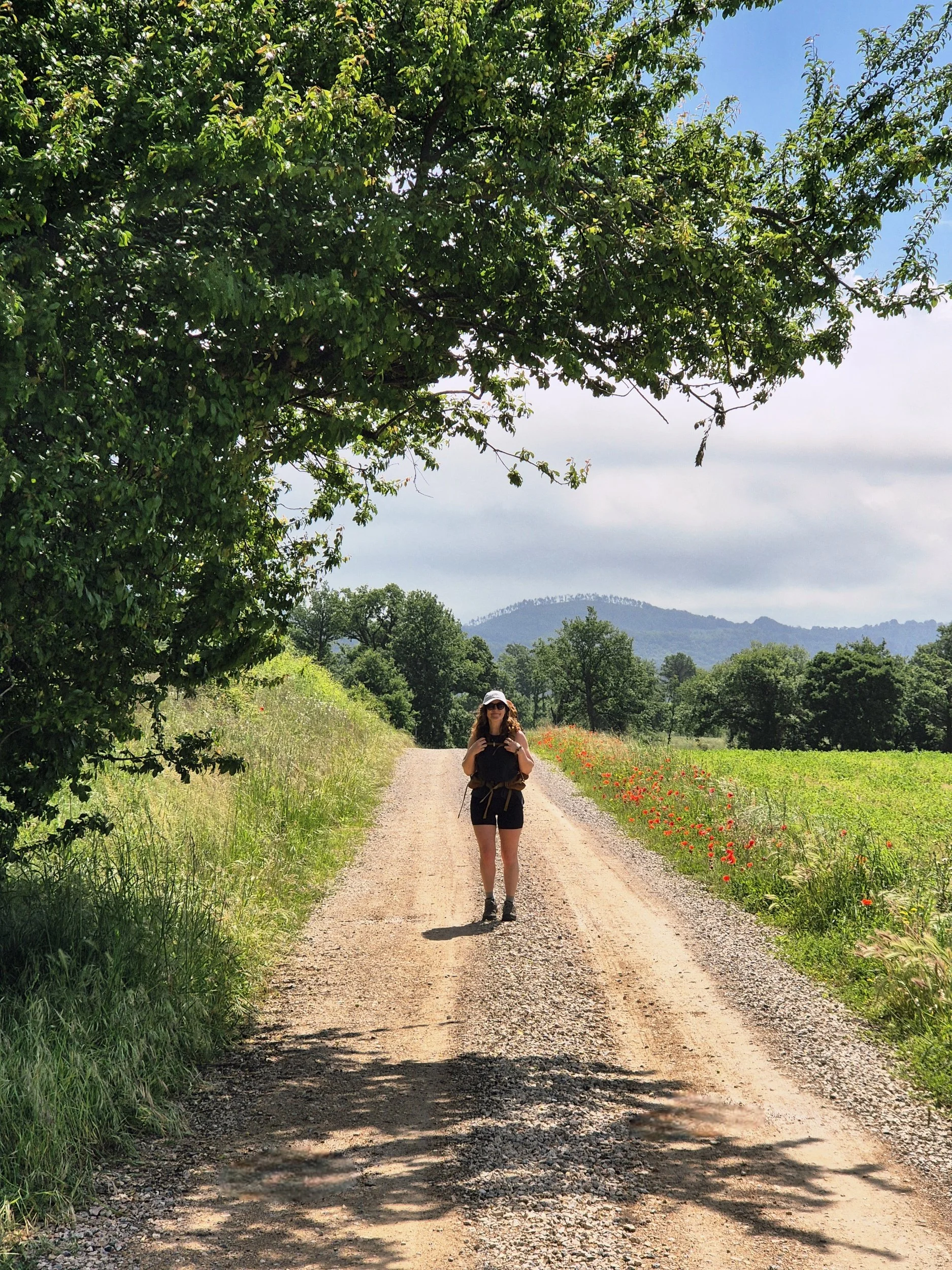
Eventually the path returns to the shoreline, where the lake becomes a constant companion. Its calm waters provide welcome opportunities to pause, cool tired feet with a refreshing swim, or simply sit for a while and watch fishing boats drift across the volcanic lake. Those small breaks become part of the journey itself, making the longer kilometres feel less daunting.
Lunch in the Piazza San Lorenzo Nuovo was one of my favourite moments of the day. Sitting beneath the warm Italian sun with a plate of fresh pasta and a glass of local wine, I watched fellow walkers and Via Francigena pilgrims arrive throughout the afternoon. Their well-worn backpacks, decorated with scallop shells and socks hanging out to dry in the heat, were unmistakable reminders that this ancient pilgrimage route continues to connect travellers from across Europe.
Cool down in Lake Bolsena
There were certainly moments when the distance seemed endless, but that's also what made the day so memorable. The promise of a refreshing swim and a shady olive grove, or an impromptu glass of wine at one of the quirky bars dotted along the shore always provided the perfect excuse to keep moving.
By nightfall we had reached the charming fishing village of Marta, where we spent the night in a lakeside apartment with uninterrupted views across Lake Bolsena making it a great location for a morning swim.
Marta to Montefiascone (16 km... or the Cheat Code)
The third stage follows the shores of Lake Bolsena before gradually climbing inland to the hilltop town of Montefiascone. At around 16 kilometres, it is far shorter than the previous day's marathon.
Now for the full disclosure.
We cheated.
After walking almost 60 km over two days, we realised we had made one crucial planning mistake—we hadn't built in a recovery day. Rather than setting ourselves up for another day of walking on tired legs, we embraced the Italian way of travelling a little more slowly.
For the princely sum of €1.20, we caught the local bus from the main square in Marta to Montefiascone, transforming what would have been a four-hour walk into a ten-minute journey. And honestly? I have absolutely no regrets.
Instead of packing up at dawn, we enjoyed a wonderfully lazy morning. Breakfast on our apartment balcony overlooking the lake was followed by an early swim in the crystal-clear waters of Lake Bolsena before lingering over coffee in Marta's quiet piazza, watching local life unfold around us.
Arriving in Montefiascone before noon gave us the luxury of enjoying a long Italian lunch, complete with fresh pasta and local wine, before wandering through the town's beautiful medieval streets at our own pace. Perched high above Lake Bolsena, Montefiascone rewards visitors with spectacular panoramic views stretching across the water and surrounding countryside.
That slower pace also meant we had time to simply enjoy our hotel. From our balcony, the elevated views across the lake were nothing short of breathtaking, with rows of elegant cypress trees punctuating the landscape below. As evening approached, we found a restaurant with uninterrupted views across Lake Bolsena and settled in for pizza as the sun slowly dipped towards the horizon, bathing the lake and surrounding hills in warm golden light.
Sometimes the best travel memories don't come from ticking off every kilometre on the itinerary. Sometimes they come from giving yourself permission to slow down, savour another coffee, take another swim, and watch one more Italian sunset.
Room with a view, Belvedere del Lago in Montefiascone
Montefiascone to Civita di Bagnoregio - 21km
Our fourth day on the trail follows long stretches of the historic Via Francigena, retracing the footsteps of pilgrims who have walked this route for centuries on their journey to Rome. The walking is wonderfully varied, passing through rolling farmland, neatly tended vineyards and the volcanic landscapes that define this corner of northern Lazio. As the kilometres unfold, wide panoramic views stretch across the countryside, with the unmistakable silhouette of Civita di Bagnoregio gradually appearing on the horizon.
The closer you get, the more dramatic the scenery becomes. Deep ravines carve through the soft volcanic rock, creating a landscape unlike anywhere else in Italy. Then, seemingly suspended in mid-air, Civita di Bagnoregio emerges from its plateau, connected to the outside world only by a long pedestrian footbridge.
Known rather dramatically as La Città che Muore (the Dying City) Civita has earned its nickname because centuries of erosion continue to wear away the volcanic cliffs beneath it. Yet despite its fragile appearance, the village has stood here since Etruscan times, quietly defying the predictions of its demise. For most visitors, however, it is simply one of Italy's most extraordinary and architecturally unique villages.
Rather than staying outside the walls, we spent the night in a beautiful house overlooking the village square, and that made all the difference. During the day, Civita buzzes with visitors crossing the footbridge to admire its beauty. But after 6 p.m., when the last of the day-trippers return to Bagnoregio, everything changes.
Suddenly, the village belongs once again to its tiny community of around sixteen permanent residents.
The silence is extraordinary. Stone alleyways that only hours before echoed with visitors become almost completely empty. Flowers spill from ancient windows, lanterns begin to glow, and every narrow street seems to lead to another impossibly picturesque corner. It doesn't feel like visiting a tourist attraction—it feels as though you've wandered onto the set of an Italian film.
One of my favourite moments was walking back down the footbridge just before sunset. Looking back towards Civita as the evening light bathed the ancient stone buildings in warm gold, the village appeared to float above the surrounding valleys. It was one of those rare travel moments where you simply stop, take it all in, and realise no photograph will ever quite capture what you're seeing.
Spending the night within Civita's ancient walls transformed what could have been a fleeting stop into one of the most memorable experiences of the entire trip. Long after the crowds had disappeared, we were able to experience the village at its most peaceful before resting up for the final day's walk back to Orvieto.
Civita di Bagnoregio to Orvieto - 18km
The final stage of the journey offers a fitting conclusion, gradually leaving Civita di Bagnoregio behind before climbing steadily towards the volcanic plateau on which Orvieto has stood for more than two thousand years. The ascent is gentle and unhurried, allowing plenty of time to enjoy the changing landscape and reflect on the previous six days of walking.
The route passes through peaceful rural countryside dotted with reminders of the region's ancient past. Along the way, you'll encounter remnants of Etruscan tombs and other archaeological features, quiet reminders that these landscapes have been travelled for millennia. As the kilometres pass, Orvieto's imposing medieval walls slowly begin to emerge on the horizon, bringing with them the satisfying feeling that you've almost completed the circuit.
Arriving back in Orvieto felt like greeting an old friend. After days spent walking through vineyards, medieval villages and along the shores of Lake Bolsena, returning to the town where our adventure began brought a real sense of accomplishment.
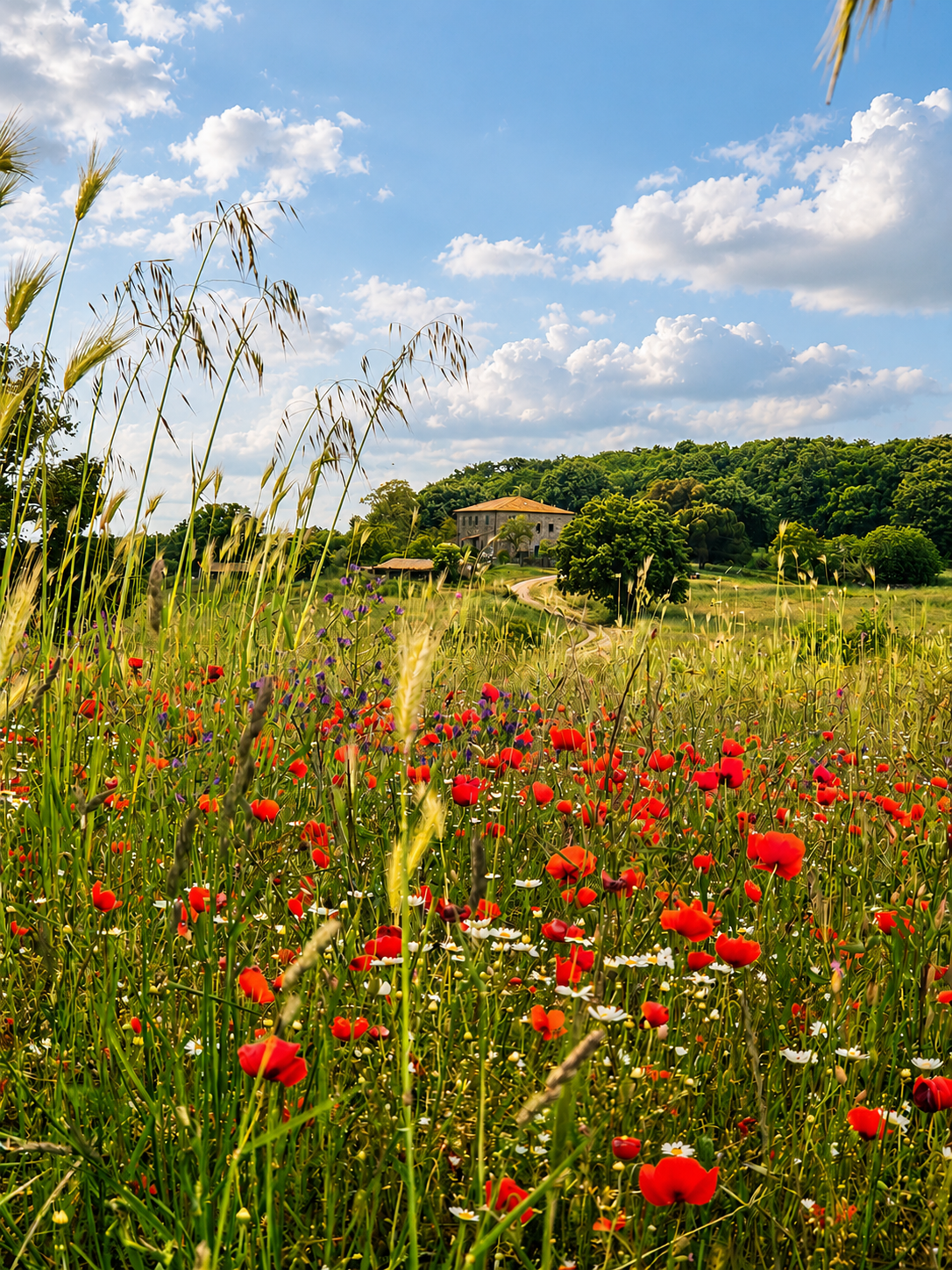
Rather than heading straight for the train, we decided to treat ourselves to two nights in the Umbrian countryside at Torre Collevento Luxury Country House. Nestled among vineyards and olive trees and tucked away among rolling hills just outside Orvieto, it proved to be the perfect place to unwind after nearly a week on the trail.
This time was devoted entirely to recovery. We cooled off in the pool, eased our weary legs with a much-needed massage, and spent a leisurely afternoon visiting a nearby vineyard to sample some of the excellent local wines. As evening fell, we enjoyed dinner on the terrace while watching the sun set over the Umbrian countryside—a wonderfully peaceful way to celebrate the end of an unforgettable walking holiday.
On our last day, we took a short taxi ride to Orvieto railway station and boarded the train back to Rome, already reminiscing about volcanic lakes, medieval villages, endless vineyards and ancient pilgrimage paths. It's a route that perfectly combines rewarding walking with everything that makes central Italy so irresistible: spectacular scenery, fascinating history, wonderful food and wine, and the opportunity to experience it all at a pace that simply isn't possible from behind the wheel of a car.
Donizetti room at Torre Collevento